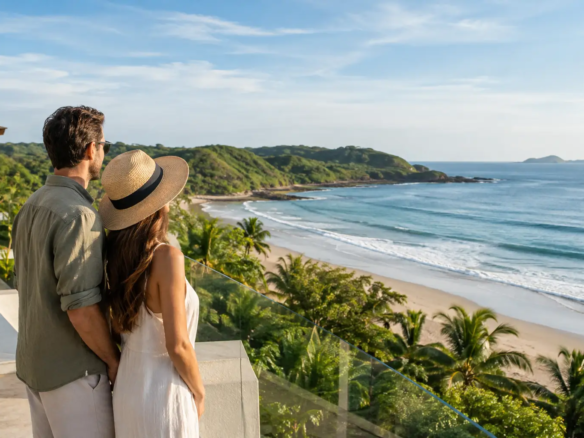

A parcel can look like a bargain from a road in Playa Venao and become a very different investment once you walk it after rain, trace the access route, and review the ownership documents. That is why Playa Venao land prices should be read as the beginning of a due-diligence conversation, not as a standalone measure of value.
For buyers coming from the United States, the appeal is easy to understand. Playa Venao combines surf, forested hillsides, an established international community, and a coastal lifestyle that still feels connected to the wider Azuero Peninsula. But it is also a small, decentralized property market without an MLS. Land can vary dramatically from one valley, ridgeline, or beach-adjacent road to the next.
The question is not simply, “What does land cost?” A more useful question is, “What am I actually buying at this price, and what will it take to use it?”
Why Playa Venao land prices vary so widely
In a standardized subdivision, price comparisons are relatively straightforward. In Playa Venao, two parcels with the same acreage can have very different practical value. One may have documented titled ownership, legal road frontage, a reliable water source, and an easy connection to power. Another may have a compelling ocean view but difficult seasonal access, uncertain water, or a tenure structure that limits financing and future resale options.
Beach proximity is a major factor, but it is not the only one. A property near the sand may command a higher asking price because of walkability, surf access, vacation-rental potential, or simple scarcity. Yet a hillside property a short drive inland can be more appropriate for a private home, small hospitality project, or buyer who values elevation, breezes, and views over being able to walk to the beach.
Topography also matters more than many first-time overseas buyers expect. Steep land can be beautiful, but it may require more engineering for driveways, retaining, foundations, drainage, and septic systems. Flat or gently sloped parcels are often easier to develop, though they should still be inspected for drainage patterns and flood exposure.
Asking prices are not a complete market report
There is no central, comprehensive public database that captures every Playa Venao listing, price change, or completed sale. Much of the available inventory is held privately by local owners, brokers, and buyer networks. That makes broad claims about average prices, appreciation rates, or market-wide price per acre unreliable unless supported by a verified dataset that is not generally available.
A listing price is an owner’s asking price, not proof of a closing value. It may reflect a recent comparable sale, a seller’s development costs, family circumstances, or an ambitious expectation. It can also be outdated if a property has been informally offered for some time without a public record.
For that reason, the most honest way to evaluate an asking price is parcel by parcel. At Love Your Land Panama, available pricing is based on the agency’s active inventory at the time it is presented, rather than a claim to represent the full Playa Venao market. Inventory and asking prices can change, so buyers should confirm availability and terms before relying on any number for planning.
The useful comparison is not just price per square meter, hectare, or acre. It is the price of usable, legally verifiable land with the access and infrastructure required for your intended use.
The value drivers buyers should compare
Title, ROP, and concession status
Panama allows foreign ownership, but the rights attached to a parcel depend on its tenure. Titled property generally provides the clearest ownership framework, assuming the title, boundaries, liens, and seller authority are properly verified. It is often the preferred structure for buyers who want the strongest foundation for resale, estate planning, or future development.
Rights of Possession, commonly called ROP, are different. An ROP property may be occupied and transferred through possession rights, but it is not the same as registered titled land. The history of possession, boundary evidence, community recognition, possible overlap, and path to formalization all require careful legal review. It may suit a buyer with a specific risk tolerance and a clear understanding of the limitations. It should not be priced or treated as though it were automatically equivalent to titled property.
Concession land brings another set of rules, particularly in coastal areas. A concession can provide a right to use land under terms established by the relevant authority, but it is not conventional fee-simple ownership. Before making an offer, buyers need to understand the concession holder, remaining term, transfer process, permitted use, fees, and renewal considerations.
A lower price can be rational when the tenure is less direct or carries more uncertainty. It can also be expensive if the buyer discovers those limits only after closing.
Road access and legal frontage
A drivable road on the ground is not always the same as documented legal access. Ask where the recorded route is, who maintains it, whether it crosses private land, and how conditions change during the rainy season. A route that works well for a four-wheel-drive vehicle may not work well for construction trucks, guests, or everyday living.
Access affects more than convenience. It influences construction cost, emergency access, rental appeal, and resale. If a parcel depends on an informal easement, have the right of way reviewed before treating the land as buildable.
Water, electricity, and communications
Water is one of the first practical questions to answer. Depending on the site, a property may rely on a community system, private well, spring, storage, or a combination of sources. Availability is not enough. Buyers should investigate reliability, dry-season performance, water quality, storage needs, and the cost of bringing service to the building area.
Electrical service can be nearby without being inexpensive to connect. Confirm the location of the nearest line, anticipated extension costs, capacity, and whether solar with battery storage is a practical part of the plan. Internet and cellular coverage should be tested on site, especially for remote professionals or owners planning to operate short-term rentals.
Drainage, buildable area, and environmental reality
The tropical landscape is part of what makes Playa Venao special. It also demands respect. Visit land in different conditions if possible, speak with neighbors, and look for water channels, erosion, unstable cut slopes, and low areas that hold water.
A large parcel may contain only a modest practical building envelope once setbacks, slopes, drainage, access, and vegetation are considered. If your plan involves multiple cabins, a villa, an eco-lodge, or rental units, preliminary site planning should happen before you assume the acreage supports the concept.
How to compare two parcels without being misled by the headline number
Start by defining the purpose of the purchase. A buyer seeking a quiet personal home can accept trade-offs that may not work for a rental-focused investor. Someone planning a future build may prioritize titled ownership and utilities over immediate beach access. A surf-focused buyer may place greater value on being close to the break, while another may prefer a view parcel in the surrounding hills.
Then compare each property on the same basis: tenure, road access, utility status, topography, usable building area, proximity to the beach, and likely development requirements. This creates a more meaningful comparison than acreage alone.
It is also wise to separate the land budget from the total project budget. The purchase price is only one part of the capital commitment. Legal review, survey work, closing costs, entity setup where appropriate, access improvements, utility connections, drainage, design, permits, and construction can materially change the economics of a property.
A practical path before making an offer
A serious offer should follow a site visit whenever possible. Walk the boundaries, assess the road, check the neighborhood at different times of day, and ask direct questions about water and power. If you are buying remotely, use video, mapping, document review, and trusted local representation, but recognize that none fully replaces seeing the terrain yourself.
Before funds are committed, have a qualified Panamanian attorney review the ownership documents and seller’s authority to sell. Confirm boundaries through appropriate survey work, investigate encumbrances, and clarify how the property will be held. The right structure can depend on the parcel, your residency and tax situation, inheritance goals, and intended use.
The best Playa Venao land purchase is rarely the one with the lowest asking price. It is the parcel whose ownership, access, infrastructure, and physical conditions match your plan well enough that you can move forward with clear eyes and a realistic budget.